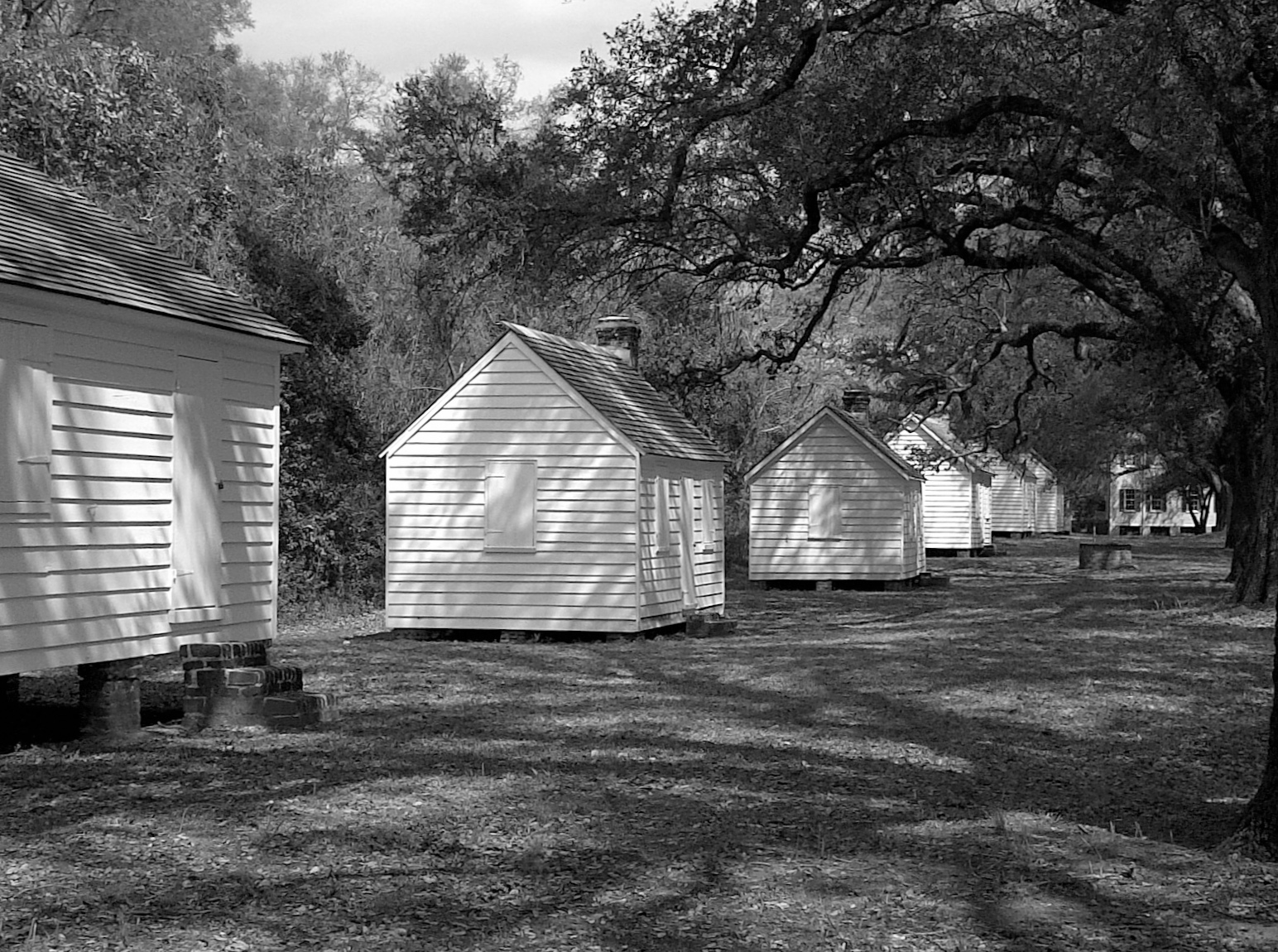
Pretty darn amazing, isn’t it? Charleston is such a cool city, there is so much history here that we take for granted. This is a photo of the slave cabins at McLeod Plantation (you can see the plantation at the end). This looks like it was taken years ago, but in reality, we were on our way back from Lowes (Why? Because Lowes Knows Value, hee hee… ) and the bridge was up to let a sailboat pass through. Traffic was backed up a bit which put our car right near the slave cabins. You would never know this beautiful old plantation sits on what is now a congested road… would you?
Charleston County Parks and Recreation acquired the McLeod Plantation for $3.3 million in 2011. The county plans to restore the site and open it to public use. Right now they have a fence up so that you can’t go on the property, so I hopped out of the car and snapped a few photos with my phone (how handy is it that phones have cameras… I mean really!), changed it to black and white and *POOF* looks like the 1800’s doesn’t it??
A little history about McLeod Plantation from South-Carolina-Plantations.com, for more info, check out THIS LINK… It’s so interesting! Here’s a little tease… for more, click on the link!
Buildings
- Current status – Plantation house and 5 slave cabins still exist and are in relatively good condition.
The old slave bell used to call slaves in from the field still hangs from an oak near the main house.The slave cabins, as well as the dairy and kitchen buildings, are believed to date from the Lightwood/Parker period (early 19th century). - Barn – Wooden structure possibly dating from late 19th century
- Dairy – Unique in that the eastern half is on piers while the western half has an enclosed root cellar
- Gin house – Two-story masonry and wood structure used to process cotton and maintained into the 1930s
- House – “The main house is a three-story, wood-frame structure. The interior has a double pile floor plan with a central stair hall and two interior chimneys. Originally the house was oriented to the south with a one-story raised porch supported by square columns. In 1925, the principal fascade was reoriented to be the rear or northern side of the house. This renovation, in the Southern Colonial Revival style, included an addition of a projecting portico with a fan light supported by four fluted Doric columns on a raised concrete porch base. A single-story kitchen was also added at that time.” (Historic Charleston Foundation)
- Kitchen – A central chimney divides kitchen in half. One side may have been used for laundry.
- Slave cabins – 20′ by 12′ wooden structures sit on raised masonry pier foundations with exterior end chimneys.
– Juneteenth Stay at Slave Cabin Offers Several Firsts – Joseph McGill, a program officer for the National Trust for Historic Preservation, documents his overnight stay in a slave cabin at McLeod Plantation in June 2010
I have company in town, so I will get back to normal posting next week! Enjoy your day and I’ll catch you back here tomorrow!
 ARTFOODHOME.COM
What a great find, Barbara, and a terrific photo. I guess I should get a different phone for moments just like the one you encountered and shared. Serendipity is the best! Have a good week!
LikeLike
I can’t tell you how many great photos I’ve gotten with this phone… I love my “real” camera, but this camera phone is pretty darn handy… who would think you could get such a cool shot (thank goodness the bridge was up!) with a phone! Have a great week Kate!
LikeLike
Hundreds and hundreds of times, I sat at that light on Folly Rd and gazed down the alley of slave cabins, wondering about it’s history. That was in the 70’s when we lived on James Island and my husband was stationed in Charleston. Today I know much more about the plantation and I’m so glad there is a way to support it! Time to plan another trip to Charleston!
LikeLike
Same here Sarah! For once I was glad I had time to hop out and snap a few photos! YES! Time to come visit Charleston again! A lot has changed since the 70’s!
LikeLike