
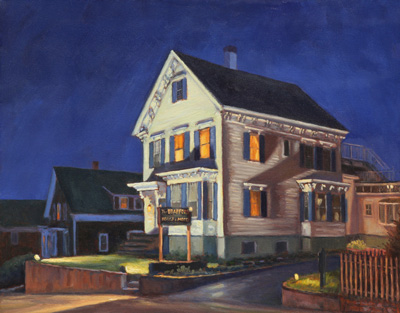
“Evening, The Bradford House” by Steve Kennedy – Image: AddisonArtGallery
Dusk. Lamps on in a house at dark. Dramatic shadows at nighttime. The wonderful deep dark blue in the sky. Lights on the house. All elements of a great nocturnal painting. This painting by artist Steve Kennedy is a great example of just that. I love his explanation of this painting (from Addison Art Gallery):
“What makes this painting of the Bradford House unique is that it was painted entirely ‘plein air’ — that is, outside, at night, directly from life. The first night a street light was utilized as light source. Before the second night’s painting session I decided a bedside night reader LED lamp would very helpful! And indeed it was. Some nights the fog would roll in while I was painting, giving the buildings an eerie glow. And water could be poured out of my palette by the end of the evening.”
I think it’s interesting hearing the story about a painting, makes it much more interesting if you’re the buyer! Here’s a blip about Steve from the Addison Art Gallery website:
In the mid 1970s, at the urging of a school instructor, Steve Kennedy began painting in the “plein air” tradition. A graduate of Paier College of Art (New Haven, CT), Kennedy moved to Cape Cod in 1981 and began focusing more on the traditional “plein air” manner of painting, working outdoors in all four seasons. He refers to his style as “painterly realism” because he works in a loose yet representational way.
While smaller paintings are typically completed in one session, for larger works Kennedy may return to the same site several times because of the constantly changing light and weather conditions. Kennedy enjoys the challenge of painting outdoors year round; intense heat and sun in the summer, snow, wind and bitter cold in the winter. He utilizes sunlight to strengthen form and create a mood, and his use of color complements the graphic patterns of light and shadow found in his paintings. He’s drawn inspiration from the rooftops of Provincetown, the harbor and streets of Gloucester, the catboats of Wellfleet, and views around cities like New Bedford and Portland, Maine.
“One of my goals is to capture the luminosity of Cape light by working early in the morning or late in the day when color and drama are at their height”, he says. In addition to capturing the light, another objective Kennedy has is balancing loose brushwork against the craft of drawing, especially as it concerns architecture and boats. Subjects are chosen carefully, with favoritism towards older more time worn themes — sometimes with a contrast of something new against it for a sense of realism. Kennedy’s typical emphasis is on street and maritime subjects. In this world of constant change, older things that somehow ‘seem more comforting’ appeal to him. He is especially drawn to places where land and water meet; he considers these areas ‘places of power.’ Influences include the work of Edward Hopper, Frederick J. Mulhaupt, John Carlson and photographer David Plowden.
Steve and his wife, Lucy, have lived on Cape Cod for over 30 years. Kennedy’s work has won numerous awards, and is in many public and private collections including the permanent collection of the Cahoon Museum of American Art, New Haven Paint and Clay Club, Cape Cod Museum of Art, Albany Institute of History and Art, Seamen’s Bank, Wequassett Inn, and the Key Bank and People’s Heritage Bank (former names, both in Maine).
Though he’s committed to plein air painting, Kennedy also works in his studio. Indoor paintings are done from photographs, sketches and field notes. The studio affords him the opportunity to capture fleeting effects of light not easily painted on location.
He has taught painting in Provincetown for many years and is a member of the North Shore Arts Association, Cape Cod Plein Air Painters and Creative Arts Center.
Catch you back here tomorrow!
 ARTFOODHOME.COM