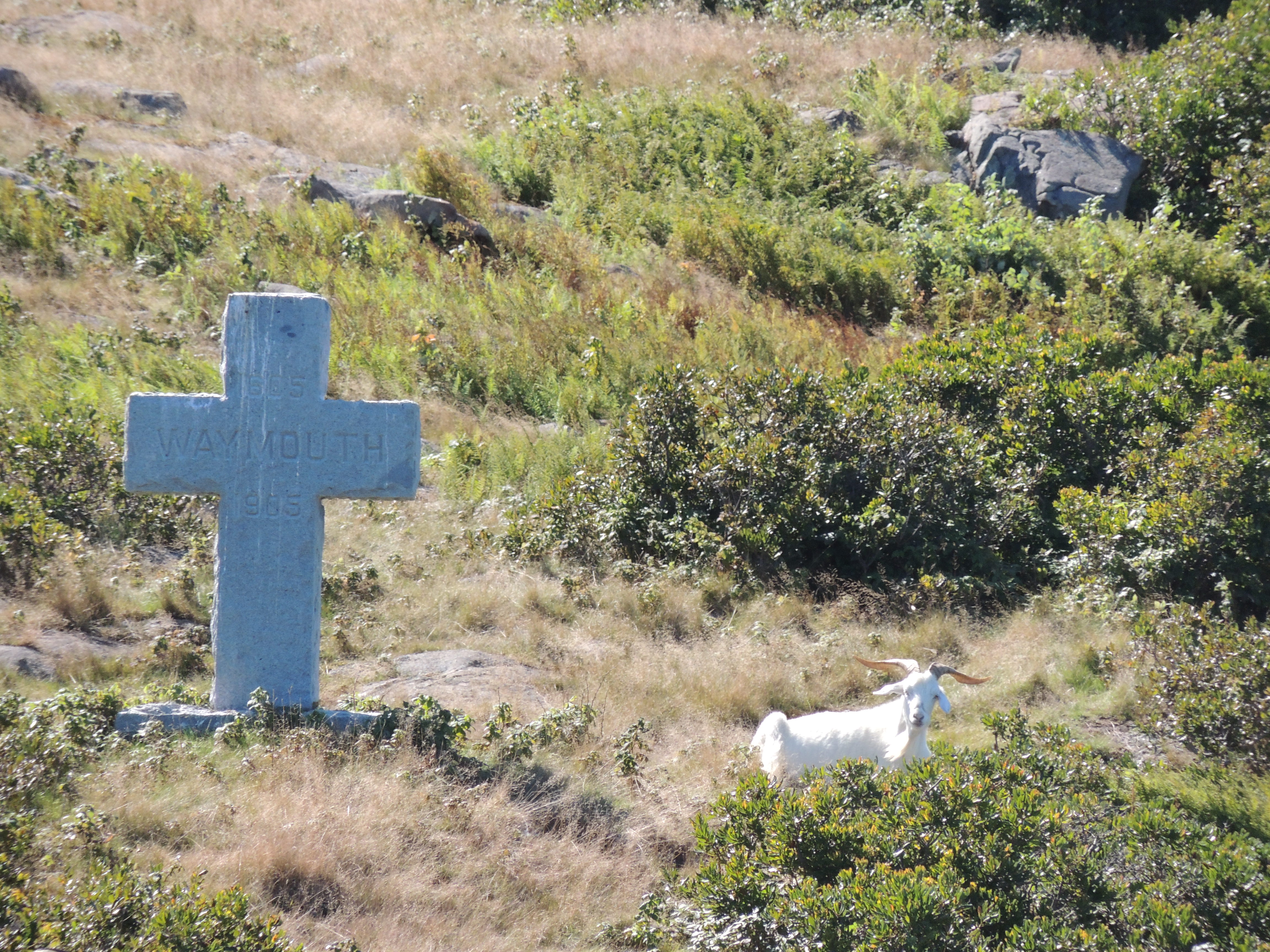
On our way to Monhegan via Monhegan Boat Lines we took a detour by Allen Island, home of Betsy Wyeth and late husband, and well known artist, Andrew Wyeth. What beauty. Like you have never seen. History and the most gorgeous setting ever. Goats meandering around, a magnificent cross, gorgeous old homes. I had to know more… what or who did the cross signify? In the history Waymouth is also spelled Weymouth, so you’ll see both spellings here. The cross clearly shows WAYMOUTH (click to enlarge), it also shows two dates, 1605 and 1905, three hundred years later…
The history: (via MaineEncyclopedia.com):
1605 |
Weymouth Cross, Allen IslandGeorge Weymouth sails from England on March 31. His expedition lands on Monhegan Island; explores the Maine coast; and kidnaps five Indians to England.He explores Allen Island where a cross was erected in 1907 to commemorate, 300 years later, Maine’s first church service held by Weymouth on the island. |
What history on that island! Can you imagine back in 1605? This is so interesting… and while researching for this post I came across a fascinating article about Betsy and Andrew Wyeth, written by Peter Ralston October 2006 (via YankeeMagazine.com):
Betsy Wyeth’s World is an Island in Maine
Friends call her island ‘Betsy’s World’
by Peter Ralston
Islands are the perfect places for Betsy Wyeth. Of the numerous islands in her life, some are metaphoric, created as home and refuge for herself and the man — the artist — she loves.
But there are also the islands with actual moats of distance and challenge, the islands she has bought and lived on off the coast of Maine. Places perfect for keeping the world, literally, at bay.
Every one of these islands is an intensely personal place and serves as muse and world to both Betsy and Andrew Wyeth. Yet in perfect counterpoint to their privacy, their lives have been shared with the outside world in the most intimate of detail for more than 65 years.
Since I was 7, Betsy’s islands have been elemental in my life. From my parents’ portion of an old Quaker mill property in Chadd’s Ford, Pennsylvania, I grew up playing down the hill on the Wyeths’ land, in the old mill itself, and particularly on their three islands in the Brandywine River. After intervening years of school, travel, and sampling the fruits of the larger world, I accepted Betsy’s invitation to come spend a Maine summer with them in 1978.
There would be no going back. I willingly fell into Betsy’s arms, which welcomed me to other islands just coming into her world. I was to be the apprentice of her newest alchemy. In 1978, Betsy bought 22-acre Southern Island, set in the mouth of a small fishing harbor, and for 12 years she and Andy lived and worked there. Southern’s beautiful Tenants Harbor Lighthouse was both home and model, if you will, for many of Andy’s remarkable paintings. Their first “real” island home, it fed a stirring in Betsy, and only a year later, when she learned that just down the coast, 450-acre Allen Island was for sale, she bought it. Just like that. And, later, Benner Island, literally a stone’s throw away, which she bought in 1989.
And she said to me, “Well, I did it. Bought Allen Island. Now what the hell am I going to do with an island this size, six miles off the coast? You helped get me into this — she’s yours in all but title. Help me figure this out and let’s have some fun.”
In her mind’s eye, she saw a 450-acre blank canvas there on the horizon. Allen was then feral territory. Like nearly 300 once year-round islands off the coast of Maine, it had lost its community, its school, its fields. It had become a seasonal home for two fishing families living in decaying houses on the fringe of the fast-encroaching spruce forest.
I had no idea this place would completely change my life.
Betsy hired a Yale School of Forestry & Environmental Studies graduate to help us develop a plan to begin taming the northern end of the island. His name was Philip Conkling, and the three of us hit it off in a very big way. (Betsy later played a pivotal role in helping Philip and me create, in 1983, the Island Institute, which is today one of the world’s premier island-oriented organizations.)
We were, perhaps, her draftsmen, but the vision and gumption to create her newest world were very largely hers. She had a vision — one as powerful as any ever imagined by any Wyeth. Betsy’s vision was that of resurrection, of reestablishing a community at sea. She envisioned a place where men could base their fishing operations, and she saw a home for herself and her husband — an ultimate refuge. To create this refuge, she has worked with the same intensity as Andy working with a single-haired brush on a master tempera. Her palette: bulldozers, boats, skidders, barges, work crews, fire, land, sea, and challenge. Always challenge.
Still there is a sense of confinement — even imprisonment — that Andy can end up feeling in these worlds Betsy constructs for them. The muse as prison, if you will, provides the setting, yet also builds the creative tension that has inspired some of his greatest works. Betsy and Andy’s long life together has often been tumultuous, but their carefully managed frisson has kept these two lovers passionate, edgy, and astonishingly productive. The competitive tension in this grand union is palpable but critical, and I cannot help but think of the Latin word for competition, competitio, whose root,competere, means “to seek together.” And of concertare, with its double meaning of “to join together, to work in concert,” as well as “to fight or to contend.”
Their respective and combined genius has always fed on competition. They have worked in concert and they will each, someday, leave great masterworks behind.
Andrew was a well known artist, and I believe Betsy is just as much an artist! Fascinating, right?! Catch you back here tomorrow!






 ARTFOODHOME.COM